
A drop date does something no meeting can. It converts every unresolved decision into a default, on a schedule, without anybody agreeing to it.
That is worth stating plainly because e-commerce operations teams rarely fail on the big questions. They fail because the launch arrives and whatever had not been settled gets settled by whoever is building product pages at eleven at night, using whatever seemed reasonable at the time.
Ai change outfit workflows add volume to that queue without adding hours to the day. So the useful preparation is not a general improvement plan. It is a short list of the decisions the deadline will otherwise make for you.
The deadline concentrates pressure where it hurts most
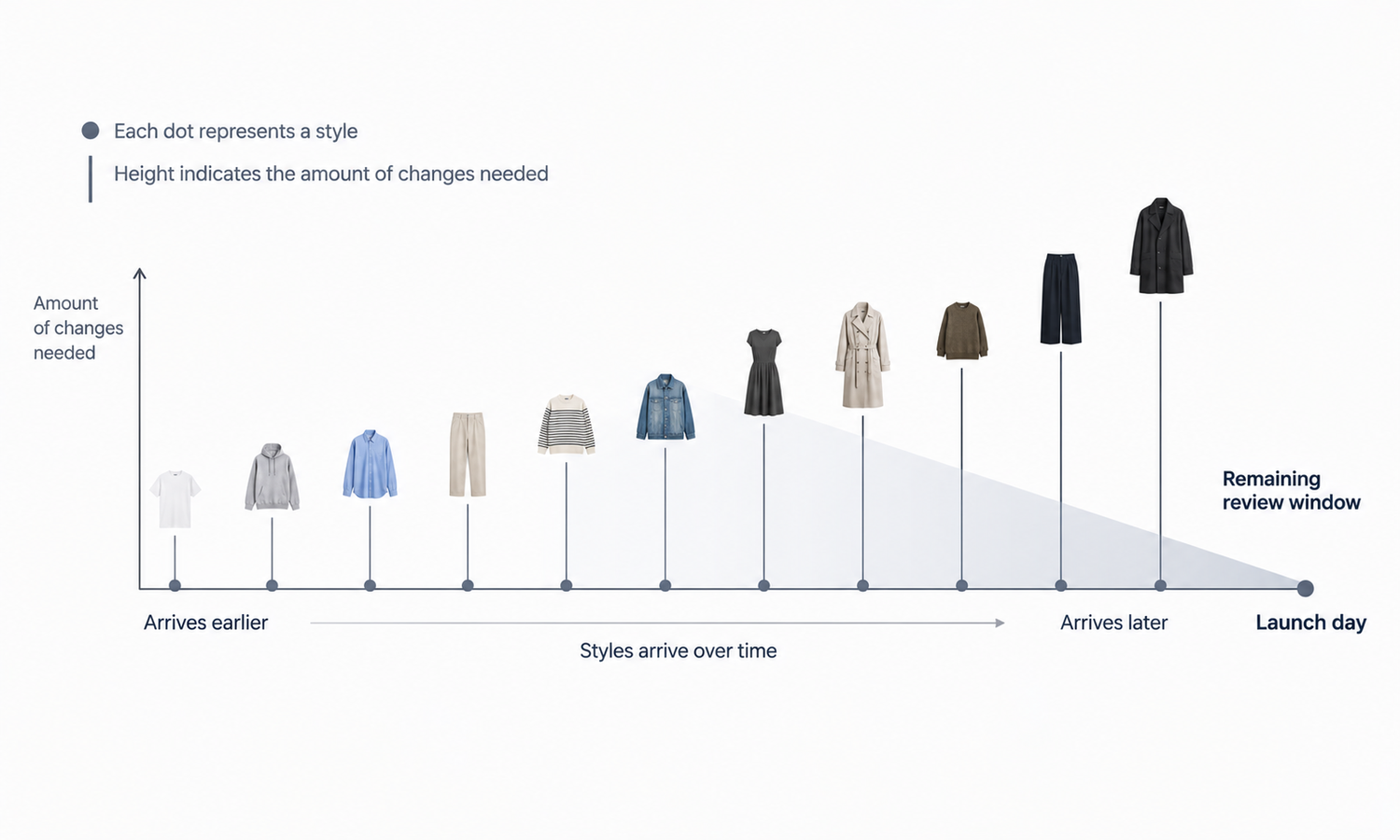
There is a second thing happening that makes the first one worse. Assets arrive in the order styles were ready, which means the last ones to arrive are the ones that ran late.
Styles run late for reasons: a sampling problem, a fabric substitution, a colorway that took an extra round, a construction that changed. Those are the same styles that most need looking at. The queue therefore delivers the highest-risk items into the smallest remaining window, and it does this every season, structurally, without anybody choosing it.
The correction is not to work faster in the last week. It is to stop letting arrival order determine review order, which is a scheduling decision available now and unavailable then.
The punch list, in the order the deadline will test it
| Decide this now | Or the deadline decides it | And the default will be |
|---|---|---|
| Review order across the batch | On the last weekend | Arrival order, which puts the styles that changed most into the smallest window |
| What gets cut when time runs short | At the moment it runs short | Whatever is quickest to skip, which is the comparison against source |
| Which categories are out of scope | After they have already consumed schedule | A retry loop on a category that was never going to hold |
| Variant count per style | While generating | More than anybody will review, paid for in the week you have least of it |
| Whether the capture standard is frozen | By somebody improving it midway | A collection page assembled from two standards, visible as inconsistency |
| What a page publishes with when assets are short | At the point of publishing | Whatever exists, checked or not, because the slot was already built |
Read the third column and the pattern is clear enough: none of these defaults are outrageous. Each one is what a reasonable person does at eleven at night with no stated alternative. That is exactly why writing the alternative down in advance is the whole intervention.
Fix the queue order, not the queue length
Most attempts to prepare for a drop try to shorten the queue. Shortening it is hard and depends on other teams. Reordering it is entirely within operations and does more.
Batch by category rather than by arrival. Group the difficult categories together and run them first, while there is still room to route one to photography if it does not hold. Group the stable categories last, since those are the ones that can genuinely be compressed without cost.
-
Put fine-detail styles early, since a wrong rivet or a wrong stitch color is only cheap to fix while there is time to fix it
-
Put anything in a documented weak spot at the front of the schedule or outside it entirely: lace and open work, sheer fabrics, complex prints, and heavily layered looks belong in the photography column rather than in the retry loop
-
Hold one buffer slot in the calendar for the style that will arrive late, because one always does, and an unplanned buffer becomes an unreviewed style
-
Run catalog-scale asset work in category batches so that a defect found in one output can be checked against the others that shared its inputs
-
Freeze the capture standard and the settings profile before the batch rather than adjusting during it, since a mid-drop change produces a range that does not match itself
That last one is the most tempting rule to break and the most expensive. A collection page is a comparison whether or not anybody designed it as one, and an improvement made halfway through a drop is visible on that page as an inconsistency.
The check that cannot be compressed
Something has to give when a drop tightens, and the decision about what should be made now rather than under pressure.
The conformity check asks whether an output matches its source. It has a right answer, and it can never be sampled, because outputs sharing a capture standard and a settings profile fail together — a clean sample tells you about the batch rather than about the images. Logos, printed text, care labels, and small hardware get compared against the source image on every single on-model output, without exception. Reconstructed detail lands almost right — a letterform slightly off, a stitch count wrong, a zipper pull the wrong shape — and almost right is what survives a compressed review and reaches a live product page.
What can give is the judgment pass. Whether an image is the strongest of the available options is a real question and a discretionary one, and it can be sampled, delegated, or answered at category level. Cutting depth there is a manageable loss.
So the order of cuts, decided in advance: variants first, then judgment depth, then scope. Never the comparison. In Lightchain AI (apparel AI) the uploaded source stays beside the outputs AI Virtual Try-On derived from it, which is what keeps the comparison a two-second job rather than a folder search — and a check that takes two seconds survives a deadline in a way that one taking two minutes does not. When a single region fails and everything else is sound, a targeted correction to that region is smaller than a rerun and keeps the rest of the batch comparable.
What the drop cannot fix later
Published assets are not drafts. A customer who buys against an image has established what they were told, and correcting the page afterwards does not reach them.
The output is a visual asset. It does not predict fit, determine sizing, model how a fabric behaves in motion, or forecast returns. Those come from measurements, a graded pattern, a physical sample, and your own data. So a size chart cannot be built from imagery under deadline pressure or any other kind, and fit copy on a page has to trace back to the measurement chart rather than to how a garment looks in a render.
No asset or launch can be presented as the reason a return rate or a conversion figure moved either, since both sit at the end of a chain running through sizing, price, assortment, and traffic. That matters at drop time because a post-launch review is exactly where such a claim gets made and then repeated for a year.
Color has a hard edge that deadline pressure pushes against. Screen color is not a physical reference, exact code matching is not something to promise, and the gap between a monitor and a roll of cloth stays open regardless of display quality. Colorways get settled by strike-offs against an agreed standard, so a shade published from a screen is a guess that a customer will check against a parcel.
The last two days, and what they are for
By the final stretch, the useful work is narrow and mostly consists of not doing things.
Stop generating. Anything produced in the last two days will not receive a proper comparison, and an unchecked asset on a live page is worse than a style that launches with fewer images. Freeze the settings. Confirm that every published file carries its style code, colorway, season, and state, because a file that goes live without them is one nobody can identify when something turns out to be wrong.
Then do one pass that nobody usually does: open the collection page as a shopper would and look at the set rather than the images. Drift between styles is invisible one image at a time and obvious in a grid, and it is the only defect that a final look can still catch cheaply. Whether the assets came from Lightchain AI or a camera, that grid is what the customer meets first.
Frequently asked questions
We always run out of time. What should we cut first?
Variants per style, then depth on the judgment pass, then scope by dropping a style to fewer images. Decide that order now and write it down, since deciding it during the last week means somebody cuts the comparison check instead, which is the one thing that reaches customers.
Should a style launch with fewer images rather than unchecked ones?
Yes, and it is rarely as costly as it feels. A page with three verified images performs its job; a page with six where one is wrong creates a support contact and a trust problem. Fewer is a merchandising compromise and unchecked is a quality failure.
Our assets arrive from several sources. How do we keep the standard?
Give every source the same capture standard with reference photographs and require the same identity fields back, rather than accepting whatever each one sends. The alternative is a collection page assembled from three different standards, which shoppers read as inconsistency without being able to name it.
When should we decide a category goes to photography?
Before the batch starts, based on the previous season's result rather than on this season's optimism. A category decided mid-drop is a category that consumed schedule before being routed anyway. Record the reason so the decision is not reopened each season.
What do we do about a style that arrives two days before launch?
Use the buffer slot if you held one, and if not, launch it with fewer images that were properly checked. Late arrival is exactly the case where the temptation to skip the comparison is highest and the risk of a difference is greatest, since late styles are usually late because something changed.
Is a post-launch fix ever enough?
For an image nobody bought against yet, largely. For one that has been live through a launch, the correction reaches the page and not the customers who already ordered. Treat published as final and plan the schedule around that rather than around the ability to patch.
In closing
A drop does not distribute pressure evenly. It concentrates it on the styles that arrived last, which are usually the ones that changed most, and it converts every open decision into whatever seemed sensible at the time. The preparation that works is small and specific: reorder the queue so difficult categories are handled early, freeze the standard before the batch, decide the order of cuts in advance, and protect the one check that cannot be sampled. Everything else on a launch plan can absorb some compression. That one cannot, because it is the only step standing between a source garment and a live page.
Start here
Open your launch calendar and mark which styles are likely to arrive last. Then check whether any of them are in a difficult category, which they usually are. Move those to the front of the review schedule now, while moving them is a calendar edit rather than an argument. That single reorder is worth more than any amount of effort applied in the final week, and it costs one conversation with whoever owns the calendar.
**Start with catalog-scale asset work → **https://www.lightchainai.com/global/solutions/scaleECommerce