
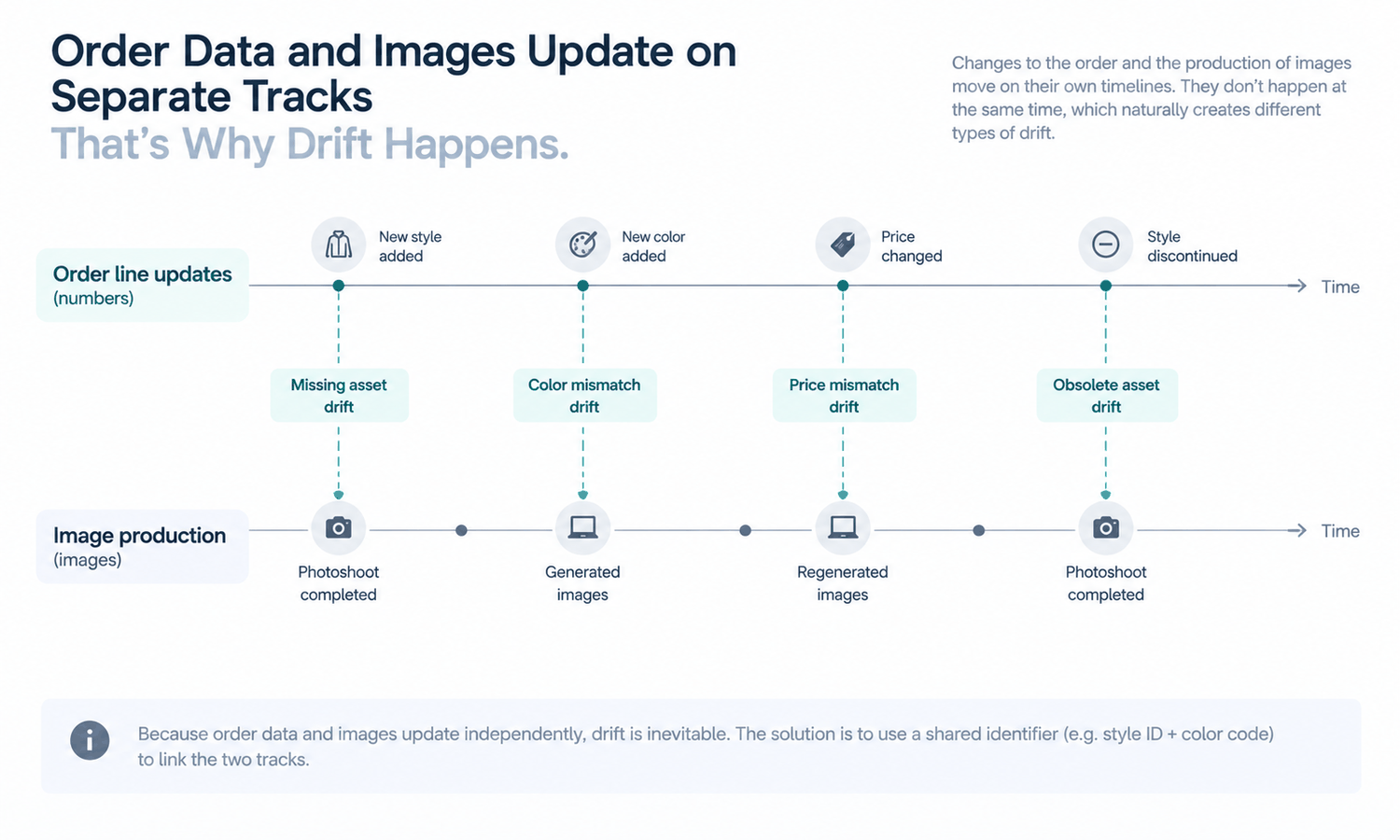
A line sheet is a promise made twice. The numbers say one thing about a style — the code, the colorways, the sizes, the price, the delivery window. The image says something else about the same style, and a buyer reads both at once without noticing they came from different places.
When those two drift apart, nothing breaks immediately. Orders get placed against a document where the picture and the row no longer describe the same product, and the discrepancy surfaces at delivery.
Generated imagery makes this more likely rather than less, for a reason that has nothing to do with image quality.
Images used to move slowly, and that was a control
Before, imagery lagged the line sheet. A style got added, a row appeared, and the picture arrived weeks later after a shoot. The lag was inconvenient and it acted as a checkpoint: by the time an image existed, the style had usually settled.
Now an image can exist within minutes of a row being created, which removes the lag and removes the checkpoint with it. A colorway added on Tuesday can have imagery by Tuesday afternoon, before anyone has confirmed the color, the price, or whether the style is going ahead.
The result is a document where images are as current as the numbers, or more current, and neither is authoritative. That is a new failure mode rather than an old one accelerated.
Teams tend to notice the symptom before the cause. Line sheets start needing more corrections, buyers ask more clarifying questions, and the conclusion drawn is usually that the range planning got messy this season. The planning did not change; the thing that used to slow the imagery down disappeared.
Where the drift actually happens
| Drift | How it arises | Where it surfaces |
|---|---|---|
| Colorway on the sheet, not in the images | Color added late, imagery not regenerated | A buyer orders a color they have not seen |
| Colorway in the images, not on the sheet | Speculative generation of an unconfirmed variant | An order for something that does not exist |
| Style withdrawn, imagery still circulating | Removal updates the sheet only | A buyer selects a discontinued style |
| Detail changed, imagery from an earlier sample | Spec revised after imagery was produced | Delivered goods differ from the picture |
| Same style, two visual treatments | Assets produced in separate sessions | The sheet looks assembled rather than curated |
The second row is the one generation introduced. Speculative imagery for a variant that has not been confirmed is easy to produce and difficult to retract, because it looks exactly like imagery for a confirmed one.
Make the row the authority
The fix is a hierarchy, stated once and applied consistently. The line sheet row is the record of what exists. The image illustrates a row that already exists. No image without a row.
That rule sounds bureaucratic and it eliminates the second and third drift types entirely. A variant with no row does not get generated. A style removed from the sheet has its imagery pulled in the same action, because the two are linked rather than parallel.
Implementing it requires one thing: the image file name carries the style code and the colorway code from the sheet. Not a description, not a season folder — the same identifiers the row uses. That single convention makes it possible to answer, in seconds, whether every row has an image and every image has a row. Keeping the files in a shared library rather than in a season folder means the comparison runs against what the whole team drew from, not against one person's export.
Agree the convention with whoever produces the assets rather than imposing it at delivery. Renaming files afterward is real work that nobody has time for, and a convention introduced late gets applied to the current season and abandoned in the next. Introduced at the start it costs nothing, because the name has to be typed either way.
Reconciliation is a five-minute job if identifiers match
Once file names carry sheet identifiers, keeping the two in step becomes mechanical.
Export the style and colorway codes from the sheet. List the image files. Compare. Rows without images are a production gap, images without rows are a withdrawal or a speculative asset, and both need resolving before the sheet goes out.
Run it at the point the sheet is issued and again before any reissue. Teams that do this describe it as tedious and uneventful, which is the correct outcome — the alternative is discovering a mismatch through a buyer.
Give the task to one named person rather than to a stage. Reconciliation is the kind of check that everyone assumes has been done by someone else, and it is only reliable when a specific person's name is against it in whatever list governs the issue process.
Where a mismatch turns out to be a color or material change rather than a missing asset, rregeneration from the approved base is usually quicker than a new production round — swapping the fabric, color or style on the existing design — see Design with Purpose.
Consistency across the sheet is a separate problem
A reconciled sheet can still look wrong. Every row has an image, every image has a row, and the assets were produced across three weeks in different sessions with slightly different treatments.
A buyer scrolling a line sheet is receiving a pattern, and inconsistency in that pattern reads as carelessness about the range rather than about the imagery. This is the same effect that makes a category page look assembled, and it matters more on a line sheet because the audience is professional.
Produce a sheet's imagery from one approved base per style and in as few sessions as practical. Where a late addition has to be produced separately, check it against the existing sheet rather than against nothing — the comparison that matters is with the neighbors it will sit beside, not with an abstract standard. Assembling the sheet's assets on one canvas and editing at the layer level makes that neighbor check a review step rather than a separate exercise. For how that consistency carries into channel assets, see Scale E-commerce.
What the sheet must never take from the image
The image illustrates. It does not supply data, and several fields exist that people are tempted to infer from a picture.
Color is the frequent one. A colorway name and a physical standard belong on the sheet and come from a strike-off; the image shows an approximation on a screen. Anyone reading a hex value off an asset has invented information.
Fit and sizing are the others. The output is a visual asset — it does not predict fit, determine sizing, model how a fabric behaves in motion, or forecast returns. Those come from measurements, a graded pattern, a physical sample and your own data, and a line sheet's size and measurement fields must trace to those rather than to the picture beside them.
When the sheet doubles as a selling document
Most line sheets are shown to buyers, which raises the stakes on everything above and adds one obligation.
State what the imagery represents. A short note — images are illustrative and reflect the sample as of a stated date — costs a line and prevents an order placed against an assumption. Where a style's imagery was produced from a proto sample rather than a production one, the sheet should say so on that row rather than in a general disclaimer nobody reads.
Buyers accept this readily when it is stated upfront and react badly when it emerges after an order. The difference is entirely in timing.
The same note also protects the seller in a quieter way. A sheet that states what its imagery reflects has documented its own basis, which turns a later discrepancy into a known and disclosed condition rather than into a dispute about what was implied. That is worth a line of text on every sheet regardless of how the imagery was produced.
Questions apparel teams ask
Why has this got worse with generated imagery? Because the lag that used to act as a checkpoint has gone. Imagery can now precede confirmation, so a picture no longer implies that a style has settled.
What is the single most effective control? No image without a row, enforced by carrying the style and colorway codes in the file name. It removes speculative assets and makes reconciliation mechanical.
How often should we reconcile? When the sheet is issued and before any reissue. It takes minutes when identifiers match and hours when they do not, which is itself an argument for the naming convention.
Can we read color values from the imagery? No. Screen color is not a physical reference, and colorway data belongs on the sheet from a strike-off and an agreed standard.
What about styles that get withdrawn? Pull the imagery in the same action as the row. Linked identifiers make that a single step rather than a search.
Should the sheet say the images are generated? State what they represent and as of when, which is more useful than a general label. Disclosure expectations vary by market and by channel and belong with whoever owns compliance.
What keeping them in step actually requires
One hierarchy and one convention. The row is the record, the image illustrates it, and both carry the same identifiers so that reconciliation is a comparison rather than an investigation. Add a note on the sheet stating what the imagery reflects and as of when, keep colorway and measurement data sourced from strike-offs and patterns rather than from pictures, and produce a sheet's assets from as few sessions as the calendar allows. None of that is difficult, and all of it stops mattering only after the first order placed against a mismatch.
Put style and colorway codes into your image file names this week.
Use the same identifiers the line sheet uses, then export the codes from the sheet and compare the two lists. Rows without images are a gap; images without rows are speculative or withdrawn. The first reconciliation usually finds something, and every one after it takes five minutes. → Design with Purpose